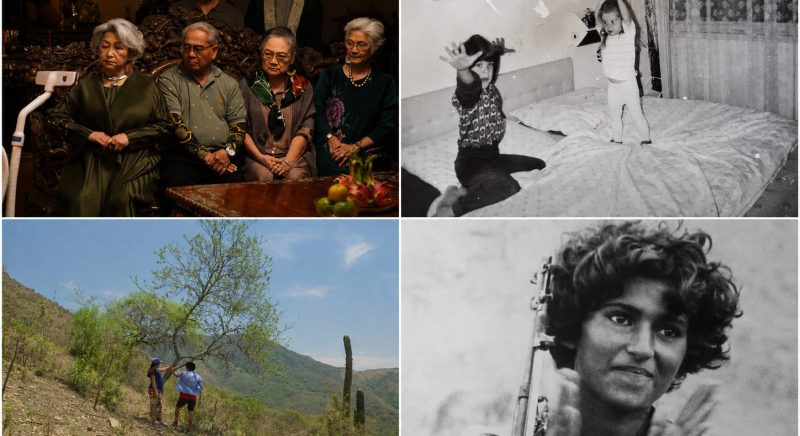
Since we occupied (Cinema) Europe last year at the Subversive Film Festival, this year, well aware of the fact that the occupation still lasts, proven by the recent events on the streets of Madrid and Athens, we continue to use film to question the situation in which these occupations occurred, but also in the context of the utopia of democracy. As with these events, so does the universal language of the art of film constantly and deeply change, breaking gender, racial, social and censorship boundaries. Maybe Assayaso's hero (code: Apres mai), tired from the revolution, has nothing else left to do but leave the barricades and projections of guerrilla activist films in the picturesque Italian piazzas and turn to making B category horrors about the battle of Nazis and prehistoric monsters. But what neoliberalism hates the most in democracy is art, because art needs time to produce results, and neoliberalism is always in a hurry. Because true art is moved by ideas. But its discourse is not a didactic and programmatical one. In a time in which the neoliberal propaganda machinery destroys everything in its path film starts to re-examine the ways in which the political and economic disorientation has affected human lives, as in the Georgian Keep Smiling, but also in the Russian For Marx.
The access to film in thematizing the utopia of democracy can be subtle, but painfully direct. This way, by experiencing film as an agora, German cineaste Romuald Karmakar (Angriff auf die Demokratie ¨C Eine Intervention) returns the art of film to the roots of democracy. In Pervert's Guide to Ideology Sophie Fiennes uses this prism of film as a full blooded lesson. The difference lies in the fact that instead of Karmakar's intellectuals who are participating in the Berlin symposium, to examine the current state of our democracy in an era in which the best solution of “saving the market” is a strategy resembling a game of poker, Fiennes uses lecturers, more specifically ¨C Slavoj Žižek. She uses various film sets instead of an agora reduced to a dark space with a microphone in front of which lecturers are trying to find a solution on how to answer the ideology of the so-called free market. Her lecturer with an aura of a star tries to show to us how to read a film. After all, we are living in a time in which Julian Assange has the status of a celebrity and films are being made about him. Such films, like Australian's Robert Connolly's Underground are skillfully flirting with the mainstream, going back to Assange's childhood when he was a hacker, although his method is not that connected with the film underground, but more plays at the rhetoric of a teen-film.
Democracy can also be an intervention. But it can also be a mocracy, in a discourse which we usually connect with the concept of a mocumentary, as Christian von Borries sees it in his crazy documentary collage (code:Mocracy) whose hallucinatory method is structured as we were drugged with various pictures from You Tube, sucked into a universe in which we are not completely sure where we are, no matter the fact that the geographical locations the author uses are known to us. According to Von Borries, today corporate propaganda becomes the means of protecting corporations from democracy. And in order to understand what the pictures are saying and in order to trust them, we need to explain them. But in today's world 98% of the states call themselves a democracy, although they are not democracies. This is how Von Borries, when he explains the found footage, actually reveals Stalinism in “democracy”, but also democracy sacrificed at the altar of political selfishness (during his visit to Kazakhstan, a minister told him that “the interest of the government is not connected with the interest of the people”, although the author is more interested in how that country in which our ministers are parading in her vivid national costumes and looking for potential investors became a EU colony). This is the reason why Neverland, as imagined by Michael Jackson is probably the only true democratic state. Neverland as a utopia of a non-place.
“You should be for something, not just against something” is Clinton's cynical message to David Letterman referring to the Occupy Movement. It is exactly in this and similar scenes, therefore, with a sort of intervention, does Ken Loach finish his eloquent documentary The Spirit of '45, to prove that resistance is not impossible after all, while using a pulsating archive material he proves that Britain's Labour Prime Minister Clement Attlee envisaged a truly welfare state which he partly achieved by nationalizing mines, steel works, docks and the Bank of England. It's interesting that Oliver Stone in a similar way also refers to a similar social concept in his seriesUntold History of the United States about the former President Henry A. Wallace who advocated communes and the principle according to which all people would share the wealth together. (The director even tries to emphasize that, if Wallace succeeded Roosevelt, Hiroshima, the Cold War, Vietnam and Iraq, would never have happened to the United States.)
Sylvain George's ingenious Vers Madrid (The Burning Bright!) begins with those same protesters with which The Spirit of '45 ended. Vers Madrid is a partisan film, the author records dialogues of the old and the young, observes human intoxication with optimism, but also the productive channeling of collective disbelief and anger. What happened at Puerta del Sol in Madrid became an event, not a movement. And the protestors the author is photographing showing their naked bodies as an expression of anger and rebellion do it quite spontaneously, unlike the hero in Scelso's documentary Model who does it because the author made him do it, in order to emphasize the exploitative relationship of cineaste and his “model”, although both Scelso's and George's nameless naked protesters are a part of the same Spanish economic everyday life which is filled with poverty.
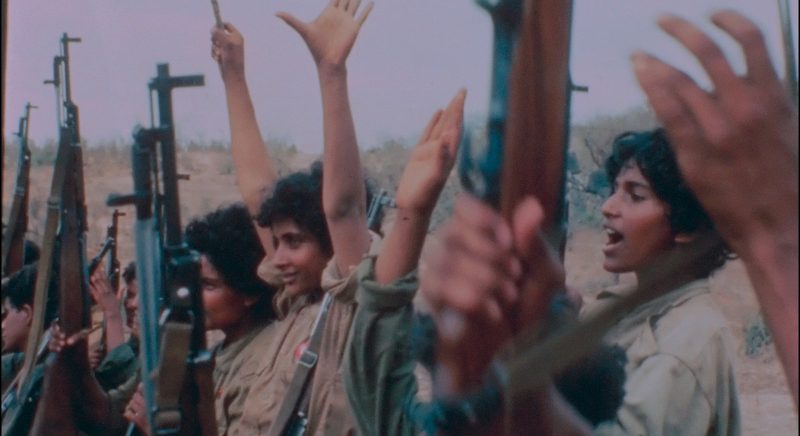
Then there are those tired of rebellion, who have returned into their little gardens, whether the garden is in Algeria (Yema) or Japan (Land of Hope). Both of the gardens, the one of the tired Yema or demented Chieko, are in place which were not that long ago struck with two seemingly different, but in the number of victims very close cataclysms ¨C war (Djamila Sahraoui) and natural (Sino Sono). Democracy was wiped out by a tsunami. What is left of it became radioactive. Of course, Sono is just one of the many Japanese (Atsushi Funahashi, Fujiwara Toshi, etc.), but also foreign authors (Jon Jost, Lucy Walker) who went to Fukushima and Sendai with their cameras to record the scenes of the post-cataclysm, where every now and then one can see an inevitable blossoming cherry tree. Because of this phrases like fetishization of catastrophe became inevitable. A new sub-genre of Japanese post-traumatic film was introduced. Luckily, Sono is does not use such exploitative discourse. But, when in The Tsunami and the Cherry Blossom Walter rummages through the ruins so she could find pieces of other people's personal belongings (photographs, albums), the scene does not differ much from the one with a child's shoe in Leo Gabriel's Syrian Aleppo or the pile of children’s rucksacks Chinese activist, artist and blogger Ai Weiwei photographed on the ruins in Sichuan. (We can see what “democracy” is in China when he later returns to the same location and the police “barges in” his hotel room).
Where Our Neverland is concerned, it is easier to shake the hand of Ilham Alijeva and Nursultan Nazarbajev, than that of Alexis Tsipras and Álvaro García Linera. Although the last two if they have time during the Subversive Forum will take a stroll to Ban's Court in a short tourist tour. And if one of our politicians go near them, we just need to say: “Keep smiling”, just as Lou Bega says in Rudsan Chkonia's film to the brainwashed housewives of Georgia.
Dragan Rubeša
@Facebook
@Twitter
@YouTube